
Tool Restoration
Sargent - Tools Of The Master Craftsman
━━━━━━━━━━━━━━━━━━━━
My first Sargent plane
1918 Type 3 No. 408
Equivalent to a Stanley No. 3
━━━━━━━━━━━━━━━━━━━━
A generous gift from family became the restoration of a 1918 Sargent No. 408 bench plane... and one of my favorite tools in the workshop.
A Gift at the Right Time
This summer has been the most oddly fun, tragic summer of my life. I'm not ready to talk about that, but one of the great things about the Summer of '22 was that I spent more time in my hometown and at my childhood home - 812 The Home, than I have in decades. Along with that, I had the unique opportunity to get to know my kid sister's fella more. I mean, I kinda knew him, had a couple Christmases together, visited a time or two, you know how that goes.

But this summer he and I spent some good time together - and it was just what the doctor ordered at that moment. So here's the thing about, let's call him Matt - it turns out he's one of those genuinely kind people. No heirs, no agenda, just - nice. Well, toward the end of my time at home, Matt, without asking for a thing in return, gifted me two planes and a breast auger. One of those planes is the subject of this post - what turned out to be a 1918 Sargent!
There's something special about restoring a tool that comes from someone you know rather than a flea market or antique store. Every time I picked this plane up during the restoration, it reminded me less of the rust and grime and more of the kindness behind the gift. By the time the project was finished, I realized I hadn't just restored a hundred-year-old plane, I had preserved the memory of one unexpectedly good friendship that arrived at exactly the right time.
Getting to Know the Sargent No. 408
Well, I kind of already told you what we're talking about - a 1918 Type 3! That's serendipitous because if you remember, about three weeks ago I restored a 1918 Stanley Bailey No. 5 plane that I inherited from my former boss. So let's take a look at this beautiful little gift...
She's in the condition one usually finds a used plane, some dings, some rust, dirty and grimy.

Aside from that, the Sargent seemed your typical Bailey plane. And here's a peek at the lever cap iron.

The History of Sargent Planes
In 1810, the Sargent family entered the hardware business, beginning the trail that eventually led to the present Sargent Manufacturing Company. Joseph Bradford Sargent and his two brothers operated a hardware business in New York City, and subsequently obtained an interest in one of their suppliers, the Peck and Walter Manufacturing Company of New Britain, CT. This company was the predecessor to the present Sargent Manufacturing Company.
The Sargent brothers bought full ownership of the New Britain firm in 1857. In 1864, they moved the factory to New Haven to be closer to the sea for shipping purposes and the delivery of raw materials, and incorporated under the laws of Connecticut as Sargent & Co.

In 1967, the Sargent family and stockholders accepted an offer for the company from the Walter Kidde Company, beginning a period of ownership by various financial groups, lasting until January of 1996 when Assa Abloy AB acquired Sargent and several of its “sister” companies. Sargent continues to operate today, focusing primarily on electro-mechanical products.
Sargent planes have been used for years on construction work from one end of the country to the other. They are fashioned from finest metals, perfectly finished and easily adjusted. They are designed to make short work of the hardest jobs, to stand up under the strain of constant usage. Yet they are so moderate in cost that they should be on every home or school work-bench. - From Popular Mechanics, February 1925
Assessing the Plane's Condition
Overall the plane was in decent condition. The surface rust I mentioned, and it was dirty. And I do mean dirty, here's a shot of the wood shavings that were compacted under the frog! Heck, might even be a kind of time capsule, carrying wood from 1818.

Aside from that, the Japanning was wearing off pretty bad. That would need to come off.

There was also some pretty deep pitting on one side. I originally thought I'd be able to fix that, but they were so deep I feared going that deep would actually weaken the body of the plane. So - we'll now consider them character marks!

Discovering the Plane's Identity
When Matt first gifted me this plane, I measured it and thought it coincided with the size of a Stanley #4. And as I've mentioned, this is my first Sargent, so I wasn't aware of their sizing and nomenclature.


It didn't strike me as much of anything, then I saw the 408 on the frog and the light went off. This is a #408, the Sargent equivalent to the Stanley #3. I'd never seen a #3 so this was a little exciting to me!

Restoration Begins
The cleaning continued. Went through paint stripper to loosen most of the Japanning, Evaporust and a degreaser bath. Have I mentioned that this plane was dirty?

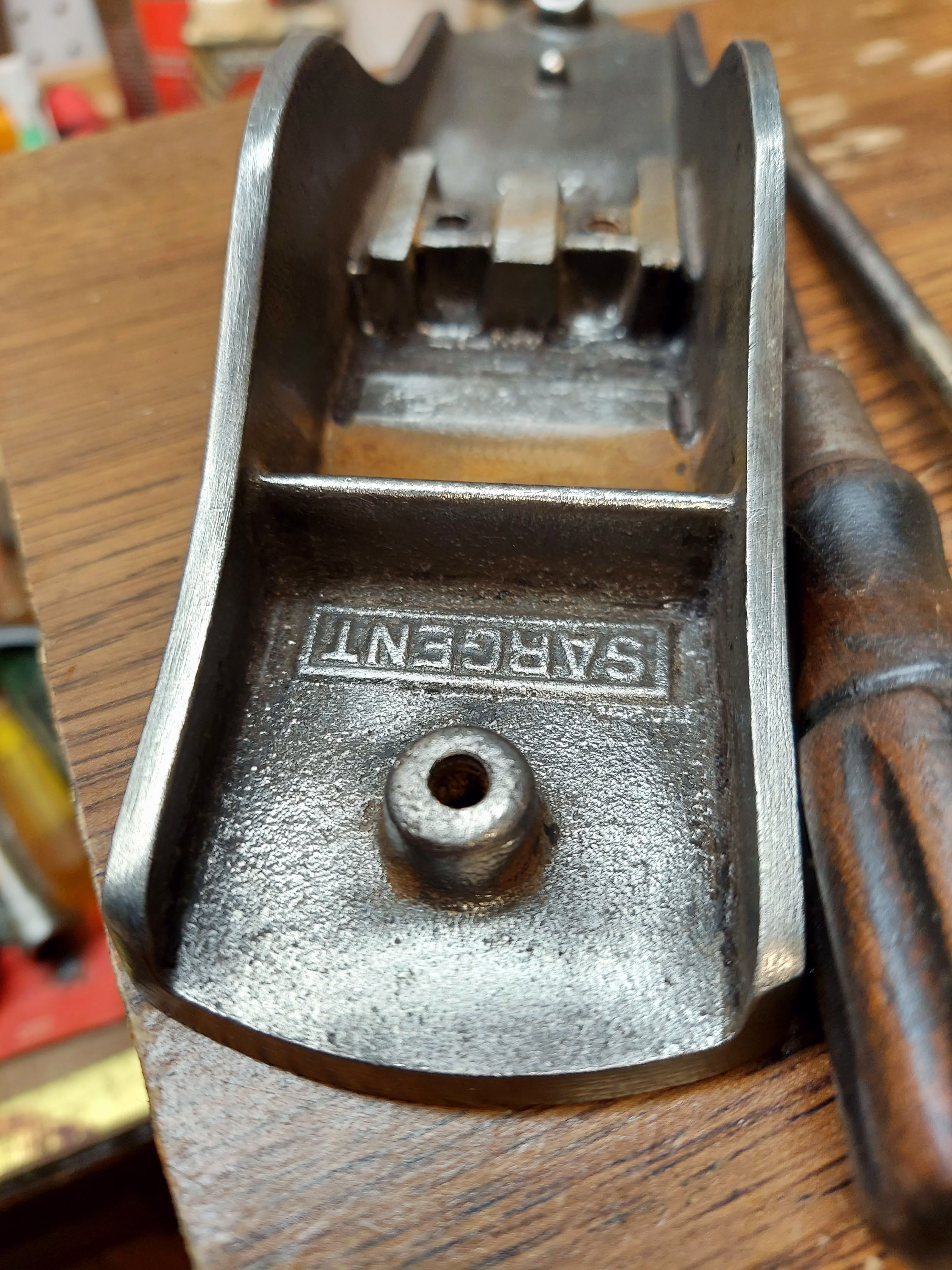
But it didn't take long for the plane to really clean up. It started to occur to me that the raised letters and numbers would show nicely if I gave it the same treatment I recently gave my Stanley #5, also from 1918!


It seemed like in no time at all the plane was ready for finishing!
Bringing the Finish Back
Here's where things start to accelerate. It's one of those projects where one spends a ton of time prepping and the finishing touches are done in the blink of an eye!

After taping off, I painted with Krylon Matte Black. I really like the Oil Rubbed Bronze I used on the Stanley #5, but I didn't want this to be an exact replica, But I really did like the muted sheen, so I went with the matte finish on this plane. Makes sense right?

As the paint dried, I went over the letters and numbers with acetone-soaked cotton swabs. I think the lettering really pops this way!

The Cap Lever, Tote And Assembly
In the same vein, I thought I'd give the lever cap the same treatment. Here's the before:

I thinned out some Testor's model paint enamel and floated in the recess of the cap. Then with an enamel thinner soaked piece of rag and some more cotton swabs, I quickly cleared the letters off.

The tote and the front handle weren't in bad shape, they were just a bit warn and pretty dirty and greasy.

I used a razor blade to clean up the tote and get down to the bare wood.

And I chucked the front handle into my drill press to sand it down. Took maybe 2 or 3 minutes.

Then a few coats of Minwax Bombay Mahogany stain. I think I've found my favorite stain color by the way!

Some Beauty Shots: Finished at Last
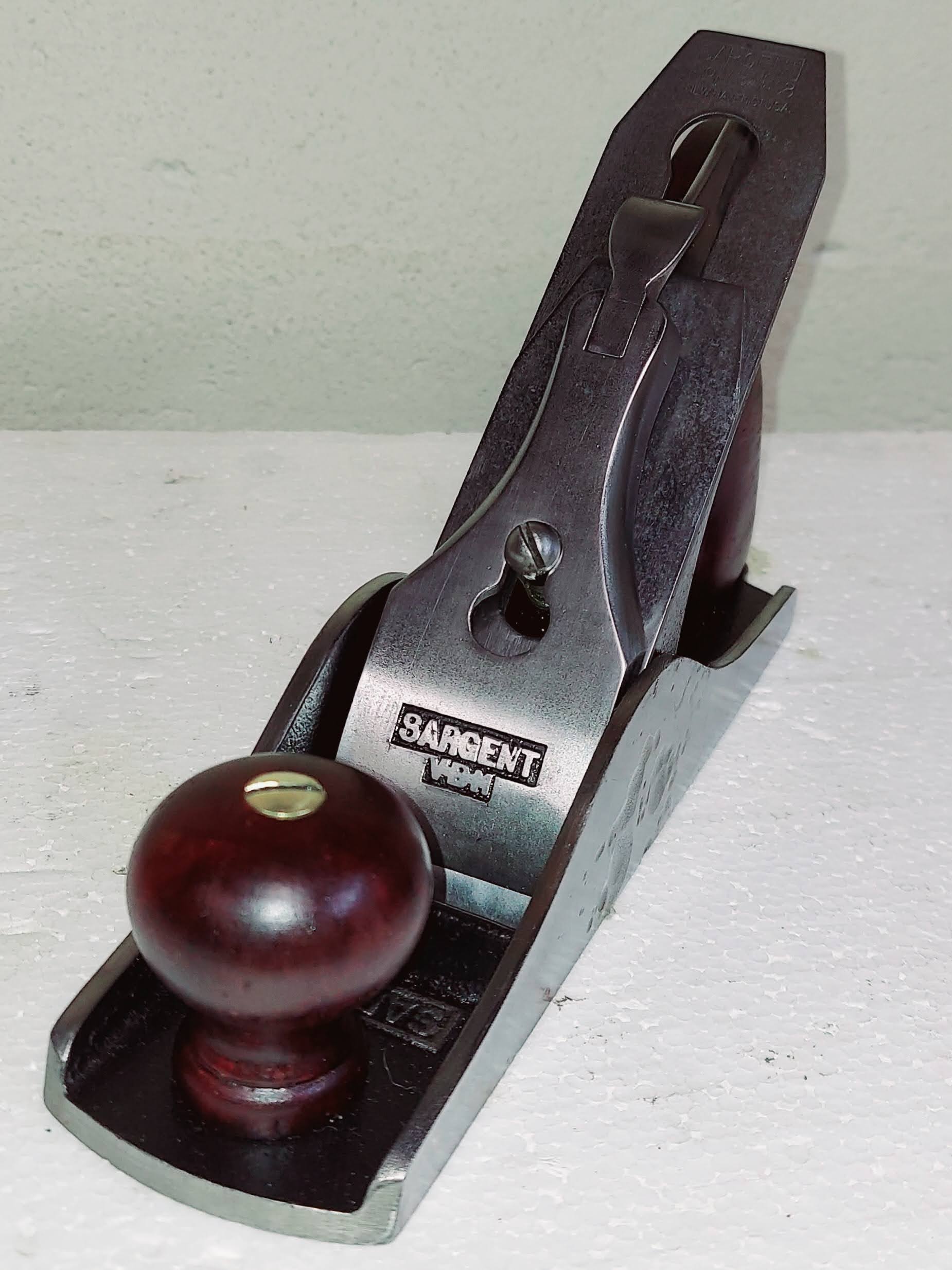
Let's take a trip down the catwalk with this one! Once again, I like the way the lettering turned out on both the lever cap and the body of the plane...


Oh - And The Blemishes

And yet, there's still a bit of a shine!

Its Natural Habitat
And here she is... stabled in her natural habitat!

So there we have it, my first Sargent plane. Thanks Matt!
See y'all soon,

I've been collecting and restoring old planes for years, so I clicked on this one the minute I saw 'Sargent.' I expected a nice restoration, but I wasn't expecting the story behind it.What stuck with me wasn't the cleaned-up metal. It was knowing where the plane came from and what it meant to you. We've all got a tool that's worth more than any price guide.I also liked that you didn't chase perfection. It still looks like a hundred-year-old plane, just one that's ready for more work.And I had to smile when it turned out to be a No. 408 instead of a 409. Been there. Half the fun is discovering something new along the way.Great restoration. Better story. - A.I. - Tool Collector
Frequently Asked Questions
What is a Sargent No. 408 plane?
The Sargent No. 408 is roughly equivalent in size to the Stanley No. 3 smoothing plane. Designed for fine finish work, it's slightly smaller than the more common No. 4 and is favored by many woodworkers for its comfortable size and precise control.
Are Sargent hand planes collectible?
Yes. While Stanley planes generally receive more attention, vintage Sargent planes are highly respected among woodworkers and collectors. Many were built to a quality equal to their Stanley counterparts and often represent excellent value on the vintage tool market.
Should original japanning always be preserved?
Whenever practical, preserving original japanning is generally preferred by collectors. However, when the finish has deteriorated significantly, careful refinishing can protect the tool while returning it to regular workshop use. The right approach depends on whether the goal is historical preservation or a dependable user.
Why restore old hand planes instead of buying new ones?
Many vintage American-made planes were manufactured from exceptionally high-quality cast iron and steel. Once cleaned, tuned, and sharpened, they often perform as well as, or better than, many modern production planes while carrying decades of craftsmanship and history.
Keywords
Sargent No. 408, Sargent plane restoration, vintage hand plane, 1918 hand plane, Bailey plane, bench plane restoration, tool restoration, japanning restoration, woodworking hand tools, House 173
Post a Comment